
Author: Ainun Asifa
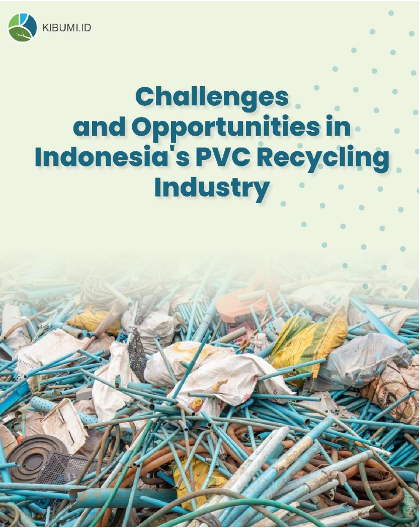
Polyvinyl Chloride (PVC) is a highly versatile and cost-effective polymer, widely used in both short-life products such as packaging, textiles, and medical devices, as well as long-life products like pipes, window frames, and roofing sheets (Braun, 2001). However, the widespread use of PVC brings significant challenges in managing the resulting waste safely and responsibly (Lewandowski & Skórczewska, 2022). Historically, incinerating PVC waste has been problematic due to the release of harmful dioxins and heavy metal-laden solid waste. Meanwhile, landfilling and open dumping are increasingly seen as the least desirable options in the waste management hierarchy (Hopewell et al., 2009). Recycling offers an alternative, enabling the recovery of materials with minimal environmental impact. In this article, we explore the challenges and opportunities in PVC recycling in Indonesia.
A study by KIBUMI (2024) revealed that only 0.2% of PVC waste reaches dumpsites, highlighting the low visibility of PVC in dumpsites. However, a material flow analysis conducted by KIBUMI (2023) estimated that Indonesia generates 687.9 KT of PVC waste annually, with just 57.6 KT (8.3%) being recycled (note that the updated data suggests that the PVC recycling is higher). A significant portion, 247.4 KT, consists of uncollectible PVC waste—such as construction materials that remain embedded in buildings or underground once they exceed their lifespan. Another 217.1 KT is lost during various stages of collection, further underscoring the inefficiencies in the current system.
The economic dynamics of PVC recycling present additional challenges. Unlike other materials, the pricing of recycled plastics, including PVC, is heavily influenced by the cost of virgin plastic rather than production costs. Geographic disparities also add complexity. Most recycling centers are concentrated on Java Island, leading to high transportation costs for the wastes to be transported to Java Island.
Regional price disparities and volatilities further reflect the challenges. For instance, rigid PVC prices at waste banks range from $0.07 per kilogram in Jakarta to $0.05 per kilogram in Kalimantan (Alexander et al., 2022). Comparatively, post-consumer PVC price remains lower than that of other plastics. These price differences directly impact the types of plastics prioritized by collectors and junk shops, creating a preference for higher-value materials.
Despite these challenges, the low recycling rate of PVC waste also signals significant untapped potential. Advancing PVC recycling in Indonesia requires a robust collection system to capture PVC waste more effectively. Additionally, optimizing extended producer responsibility (EPR) programs can significantly boost both collection and recycling rates by involving producers more actively in the management of the end-of-life of the post-consumer PVCs.